Updated: Sep 17

When I was ten years old my favourite Christmas gift was a Jon Gnagy art set. Gnagy was the first TV art teacher and his kits contained workbooks, pencils, charcoal sticks and strange art erasers.

I happily created pictures at the dining room table while my grandma, aunts, and uncles all chatted around me. When I visited my other grandmother, she taught me to hook rugs, to sew on her old Singer, and gave me strips of fabric to braid which we then stitched into braided mats. And I wrote about all of this and much more in my little locked diaries.
Sometimes we think of creativity as perfecting an art. But creativity is really exploring new things without worrying about failure.
As a young teacher I used every bit of creativity I could muster to engage and instruct and nurture five to ten year-olds. Try keeping 35 little ones productively busy on snowy days when it’s too stormy for recess or lunchtime outings!
My own children developed their creative skills as I practiced with oil paints. And there were stories to write and games to create and portraits to finish.
Later we moved to a different province and there I worked on two degrees in education and administration. I was able to replace some education courses with electives and luckily the university had a wonderful art department. I studied art history, figure drawing, acrylic medium, and a variety of art techniques including working with clay.
My art journey had taken a shift from “same old” to “let’s explore”.

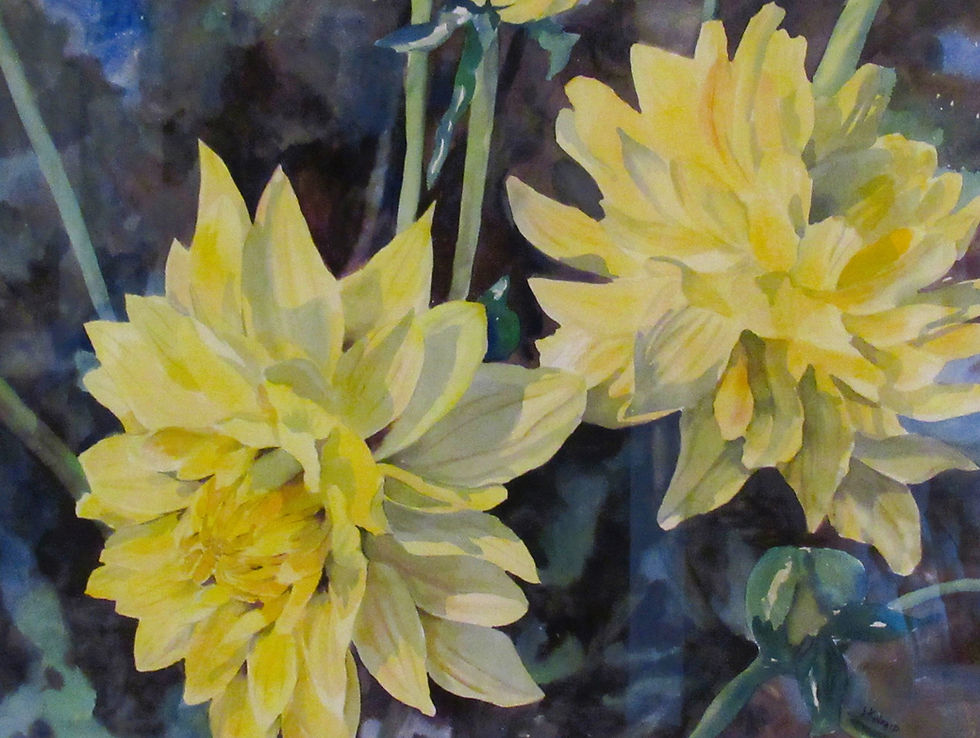
Six years later we were back home and I was happy to join in the art community taking courses and joining art groups where I participated in juried exhibitions and art shows. I left acrylics and discovered watercolours. My creative journey was getting broader as I began working as an art gallery administrator producing art exhibitions and arranging art classes.
You can be sure I picked great instructors and participated in all of their classes! I became a partner in a small framing company that catered to watercolour artists and I travelled the area taking my frames to art groups and getting to know the local talent.

A new career presented itself, the development officer for a national church (translate as chief fundraiser.) Now my creative journey took quite a shift. I made materials of all kinds to facilitate support for the work being done worldwide: greeting cards, donation envelopes, Sunday bulletins, magazines, conference displays, public speeches, a website, a published book, children’s resources, and even sermons!


Nowadays as a retired senior, my walls are filled with paintings and I no longer feel compelled to create finished works. I doodle in my art journals and love experimenting with every medium and style I hear about.

Luckily, I have friends that join me and a daughter and grandson who inspire and teach me.

Creativity has been a journey as real as my world travels. Sometimes it has been about developing a skill or about making something that lasts. Other times and for all of us, I think creativity can be finding adventure in something new.
Or perhaps creativity is simply a way of approaching life.
Updated: Aug 21

[NOTE FROM JAN: Don't know about you, but seeking joy is on my to-do list everyday. Of course, some days require a little extra effort to find it. If today is one of those days for you, I double-dog dare you to read this post without feeling at least a flicker of a smile trying to tickle your lips. It's by my friend and sister creative, Karen Kirkpatrick, and I hope you love, love, love reading it as much as I did. Take it away, Karen!]
Back in the early oughts, which still seems like it was just last week, I stood on a street lined with Victorian houses in the Inman Park neighborhood of Atlanta, sure I must be imagining things. The blare of trumpets and thump of drums reached my ears first, but soon the unmistakable sound of an entire marching band punctuated by whoops and cheers reached my ears. In the next minute, a flamboyance of wildly dressed adults – sequins, boas, and flowers in a riot of color – rounded the corner. They skipped and danced and grinned. They waved at the crowd lining the street and laughed and looked like they were having more fun than the law allows.
I wanted to have that much fun.

I’m a writer by trade. Not books, though I’ve tried my hand at that, but magazine articles, education pieces, economic development work. And I’ve managed to make a living at it. But, oh, how I missed having something creative in my life.
I live in Marietta, about 30 miles from Little Five Points, the neighborhood the Seed and Feed Marching Abominable calls home. When I first saw them, it seemed too far to go to be in a band. I back-burnered the idea. But it kept niggling at me. And in 2010, when I was working in Midtown Atlanta, near Little Five, writing about electrical work and trying not to kill anyone with mistakes in my how-to guides, I joined the band.
I hadn’t played the alto sax since the Marching Chiefs at Florida State University in the 1980s – and I wasn’t that good then. (I learned early on that even last chair gets to go on the trips and have all the fun.) But none of that mattered. For the Seed and Feed, no auditions necessary. The only requirement for being an Abominable: a desire to spread joy through music.

My first band friend was a man who didn’t pick up an instrument or read music until he was nearly 50. This group of people, aged from early 20s to 80, welcomed all comers. Before the first rehearsal was over, I knew the names and had contact info for half a dozen people. Before my first gig – the Saturday after that first Tuesday night rehearsal – I had offers of costumes and tips for how to play music on a carousel and while going down an escalator without falling on your face – or horn.
Soon I was right at home among this group of business owners, doctors, lawyers, students, scientists, teachers, and every other profession – or lack of – you could imagine. Over the last16 years, I have made wonderful friends, played good music, had more fun than I ever dreamed possible, and helped bring joy to parades, weddings, conventions, sporting events, festivals, even funerals.

Thankfully, for many people in the band, the music is the most important. So we sound as good as we look. For me, though, it isn’t practicing or playing perfectly that’s the draw. The joy comes from making music with friends and seeing a smile light up a child’s face as a marching band comes down the street.
For me, the band has always been the thing.

Karen Kirkpatrick has made a career out of writing and editing for magazines, corporations, universities, books, and more. Learn more about her professional life on her Linkedin profile.
[ENDNOTE FROM JAN: Check out upcoming appearances of the Seed and Feed Marching Abominable. These folks truly DO spark joy! P.S. to Karen: Thanks for today's grin.]
Updated: Jul 24

[NOTE FROM JAN: In June, I gave a hats-off to the organizers of Art in the Vines, an open-air art market at Qualusi Vineyards in Acworth, Georgia, one being the delightful Michelle Carpenter. So imagine my dismay when I discovered I ran photos and links to another artist named Michelle Carpenter, also delightful, but not the one I intended to spotlight. Given the givens, I asked the Michelle Carpenter with Modern Context if she’d write a guest post about her creative process. She said YES!]
SO NOW ... HERE'S MICHELLE with HOW COMMUNITY BROUGHT MY CREATIVITY BACK
For more than a decade, my artistic practice was mostly dormant.
Creativity still showed its face periodically—through personal home renovation projects or professionally in my marketing and strategic partnerships work—but I no longer thought of myself as someone with an active creative practice. Art was something I had once done, something I occasionally returned to, but not a consistent part of my life.

That began to change when I moved to Acworth, Georgia, after growing up in rural Michigan.
As I started settling into my new hometown, I found myself asking a simple question:
What if I actually knew my neighbors?
And then another:
What if participating in my community became my extracurricular?
Rather than treating community as something happening around me, I began looking for ways to take part in it. I attended local events, spent more time downtown Acworth, supported local businesses (over shopping online) and became increasingly curious about the people, places and organizations shaping Acworth.
Over time, the town began to feel less like the place where I lived and more like a place I belonged.
As my connection to the community strengthened, so did my inspiration and drive to create.

Classes at Acworth Arts Alliance’s Art House became an important part of that return. I explored—and still explore—a range of mediums, giving myself permission to experiment without needing to know exactly where it would lead. Those classes reignited my creative curiosity while also creating space for friendship and connection with both current and new friends.
(An art class is a great way to spend time with a friend, by the way.)
Eventually, I began spending more time creating. And when I looked for inspiration, I kept returning to the community that had helped bring my creativity back.
Now, as a printmaker and collagist (still working to fully commit to these labels confidently!), I create mixed-media pieces featuring some of the physical places that contribute to the quality of life in Acworth. These are not simply buildings or landmarks. They are gathering places, small businesses and familiar corners of town that hold stories, memories and relationships.

They are places where people meet for coffee, celebrate milestones, support one another and build a life together.
Creating work inspired by Acworth has changed the way I see the community. Art encourages me to slow down, look more closely and notice the details I might otherwise pass by. At the same time, participating in the community gives me more to notice.
The two practices continue to strengthen one another.
I used to think inspiration required getting away—traveling somewhere new, encountering unfamiliar places or stepping outside my normal routine. There is certainly value in all of those things. But I have also learned that inspiration for creation—from writing to painting and everywhere in between—can come from the world immediately around us.
All we have to do is look around and really see, and feel, what is there.

That may mean noticing the way light falls across a familiar building. It may mean listening to the story of a local business owner, paying attention to the rhythm of a neighborhood or recognizing the history held within a place you pass every day.
It may also mean noticing what happens inside you when you begin to participate.
For me, community involvement did not begin with a formal role or a clear plan. It began with curiosity. I showed up. I took classes. I attended events. I met people. I learned more about the place I had chosen to call home.
The deeper involvement came later.
Belonging was not something I found all at once. It grew through small, repeated acts of participation.
Take a class. Visit a local business. Attend a local event or city meeting. Introduce yourself to someone when you walk your dog.
Acworth did not simply become the subject of my artwork. Becoming part of Acworth, and the people who shape it every day, helped me become an artist again.
And it all began with one question: What if I knew my neighbors?
The next question: What if you knew yours?

Michelle is a strategic marketing and communications consultant with HL Strategy, artist and community advocate based in Acworth, Georgia. She serves on the board of the Acworth Arts Alliance and the City of Acworth public art committee, and explores the connections between creativity, community and place through her professional and artistic work.
View artwork on display in the members gallery and current exhibition at Acworth Arts Alliance’s Art House
To email her, copy and paste the following into your browser: michelle@moderncontext.co
You can also connect with or follow her through the social media links below:
Instagram: @moderncontext.co
